
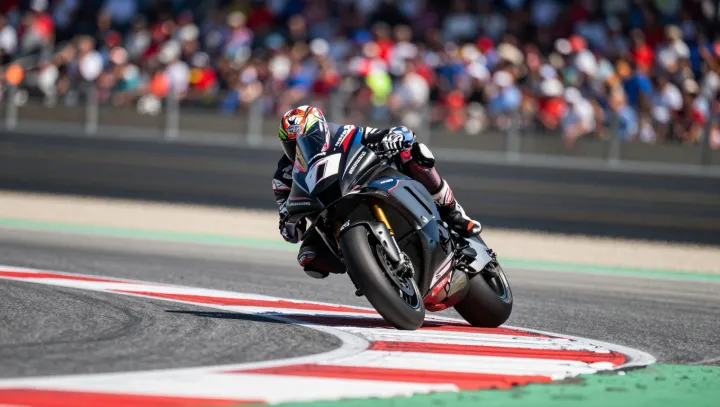
Lap records fall even when riders back off to keep tires from destroying themselves at speed. The paradox sits in the physics of rubber, fuel mass, and race strategy rather than in some mystery of courage or risk.
Modern race rubber delivers peak coefficient of friction in a narrow temperature window and then drops off sharply as thermal degradation accelerates. Overheating raises hysteresis losses and causes blistering and tearing, but it also signals that the tire is initially operating at extreme grip. Early in a race, with a full fuel load, bikes carry more inertia and stress the carcass harder, driving temperatures up. Later, as fuel mass falls, cornering loads and slip angles change, allowing riders to use less lean and cleaner lines while still generating high lateral acceleration.
That shift combines with tire wear in a counterintuitive way. As tread rubber thins, contact patch shape and effective spring rate change, sometimes improving mechanical grip and reducing rolling resistance. With less fuel, reduced drag, and slightly scrubbed tires, riders can run a more efficient apex speed profile and later braking points. The engine still produces the same torque, but the power‑to‑weight ratio improves, so acceleration off corners gets sharper even if riders manage throttle to avoid temperature spikes.
The flawed tire becomes something to game rather than a pure limit. Riders nurse the rubber in dirty air, then unleash short qualifying‑style bursts when fuel, carcass stiffness, and surface temperature align. Governing bodies may clamp down on compounds and pressures, but as long as thermal management and vehicle mass evolve through a race, the clock remains vulnerable.