
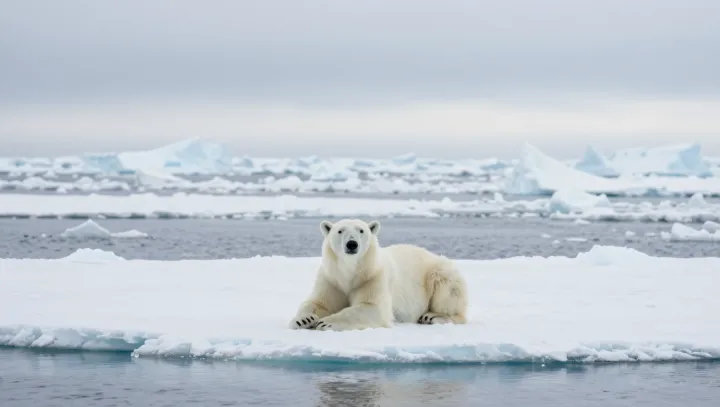
A polar bear can fill a camera frame yet barely register on an infrared sensor. The animal carries hundreds of kilograms of tissue, but its thermal signature often fades into Arctic background. The explanation lies in how its body manages heat at the skin and fur interface.
Beneath the fur, a thick layer of adipose tissue forms a powerful barrier to conductive heat loss, lowering effective heat flux from the core. Above that, the fur behaves like a complex optical and thermal filter. Each hollow hair shaft traps air, reducing thermal conductivity, while the dense coat creates multiple scattering paths for both visible and infrared radiation. Incoming solar radiation penetrates, is partly absorbed by dark skin, and then re-emitted, but most of that longwave radiation is scattered and absorbed within the fur rather than escaping directly to the environment.
For an infrared camera, which detects emitted thermal radiation rather than mass, the result is counterintuitive. Surface temperature at the outer fur approaches ambient air temperature, shrinking the temperature gradient that drives radiative emission. That makes the bear’s outline faint compared with less insulated animals whose skin is closer to core temperature. High thermal resistance, low emissivity at the fur surface, and strong control of convective heat loss together allow the polar bear to conserve metabolic energy while remaining close to invisible in the infrared spectrum.