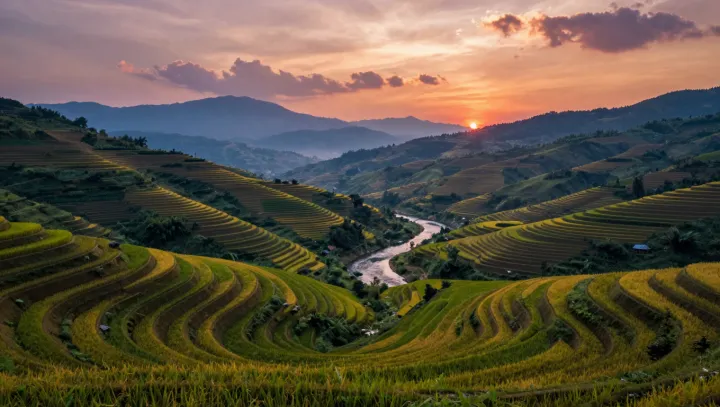
Light over the Longji Rice Terraces changes faster than most itineraries allow. By the time day‑trippers step off their buses, the sun is already flattening the slopes into a single bright sheet; by the time they leave, the terraces have not yet played through their full cycle of mist, shadow and reflected sky.
Seasoned drivers say the one‑day rush is the slowest way to see Longji because it locks visitors into a narrow time slot and a fixed, high‑traffic route. Group schedules funnel people to the same viewpoints, at the same hours, under the same harsh light, creating a kind of visual entropy in which every photograph and every memory converges toward the same low‑information image. The mountain village, by contrast, becomes a base camp rather than a checkpoint. An overnight stay widens the observation window to dawn, dusk and deep night, when terraces mirror the first pale light, when fog lifts in layers, and when village soundscapes replace engine noise.
Staying on the ridge also alters the marginal effect of each extra hour spent there. Instead of adding more of the same scenery, time begins to reveal different strata of the place: farmers adjusting water levels, the smell of soil cooling after heat, stars mapping the curve of the hills. Drivers argue that the physical distance covered in a day trip grows, while the sensory distance barely moves. Slow time in one village, they suggest, is the only way the landscape stops being a backdrop and starts behaving like a living system.