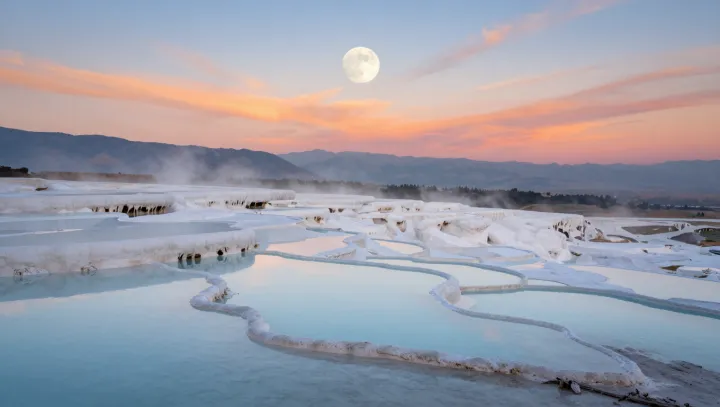
White cliffs rise under a pale sky while hot-air balloons drift above them, all because underground rock once fractured and let heated, mineral-rich water surge to the surface. That geological accident set in motion a slow chemical process that still builds Pamukkale’s so-called cotton castle today.
Tectonic activity opened deep faults, allowing groundwater to circulate, heat up and dissolve calcium carbonate from subsurface rock. When this pressurized water emerged as hot springs and met cooler air, degassing of dissolved carbon dioxide shifted the water’s equilibrium, forcing calcium carbonate to precipitate as travertine. Layer upon layer of this limestone formed stepped basins whose bright surfaces reflect light with unusual intensity, turning the slopes into a natural amphitheater for dawn.
Because the hydrothermal system remains active, thin films of supersaturated water still flow over the terraces, continuously depositing new mineral crust. Regulations now channel visitors away from many pools, but controlled access and designated flight corridors let balloons rise over living travertine rather than fossilized rock. The combination of ongoing carbonate deposition, steep relief and stable morning air masses creates a narrow window where a working geochemical system doubles as a launchpad for sunrise flight.