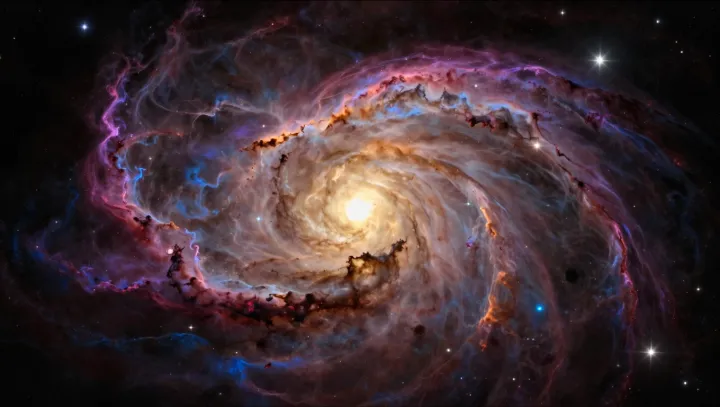
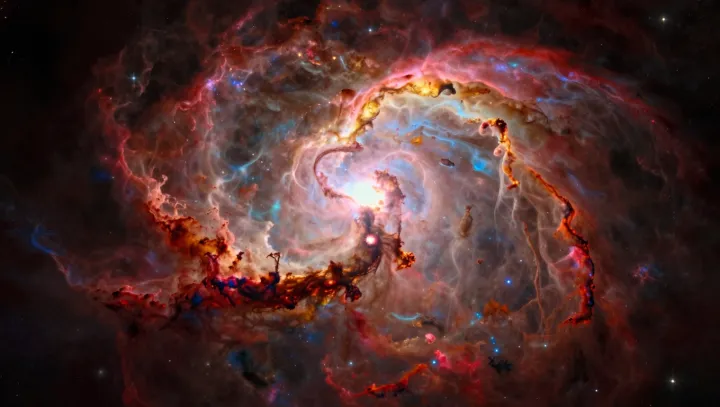
That Milky Way on your laptop is lying. Not because astronomers fake it, but because the galaxy is too faint, too sprawling, and too multi‑wavelength for any sensor to trap in one exposure. What looks like a casual sky snapshot is usually a composite product of long integration times, stacked frames, and data from parts of the spectrum that human retinas simply ignore.
The basic trick is ruthless: one patch of sky, shot again and again. Short frames fight atmospheric noise; software performs image stacking to boost signal‑to‑noise ratio, then subtracts hot pixels and gradients. Wide swaths are tiled into a mosaic, like a celestial survey map, guided by astrometry so every star lands in its correct coordinate grid. A single glamorous arch of the Milky Way can hide hundreds of individual panels, each tracked on an equatorial mount to cancel Earth’s rotation and keep the galactic disk from smearing into a pale band.
The most unsettling part is that your favorite wallpaper is not even limited to visible light. Infrared and radio observations, collected by sensors tuned to wavelengths that never reach your eyes, are remapped into false‑color channels, riding on top of ordinary RGB data. That process, closer to data visualization than photography, reveals dust lanes, hydrogen emission, and star‑forming regions through techniques such as narrowband imaging and photometric calibration, turning the sky on your screen into a carefully engineered translation of physics, not a simple night walk memory.