
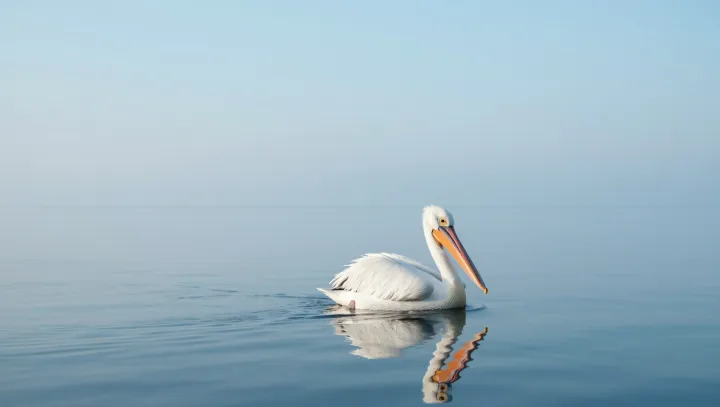
A bill that looks like a teapot spout can operate more like precision industrial hardware. The distinctive curve and depth create a scoop that channels water and fish while keeping drag manageable in fast, low-altitude flight close to the sea surface.
Over generations, natural selection tunes bill morphology as a trade-off between hydrodynamic resistance and structural strength. Bone density, keratin layering and cross-bracing trabeculae raise the moment of inertia of the bill, allowing it to withstand repeated impact with water while capturing prey. This design aligns with fluid dynamics constraints: a broad leading edge stabilizes the flow, while internal air spaces and lightweight architecture protect the bird’s overall mass budget and basal metabolic rate.
That same structural efficiency turns dangerous when a fast-moving bird intersects an even faster aircraft. Relative impact velocity multiplies kinetic energy according to the standard one-half m v squared relationship. A seemingly fragile fish-scooper becomes a dense, reinforced projectile; on collision, force transfers over a small contact area of the fan or compressor blades, risking localized plastic deformation, blade fracture or secondary foreign object damage throughout the engine core. Evolution that optimizes for feeding at the air–water interface inadvertently creates, under rare alignment of flight paths, an organism capable of serious mechanical disruption to turbine machinery.