
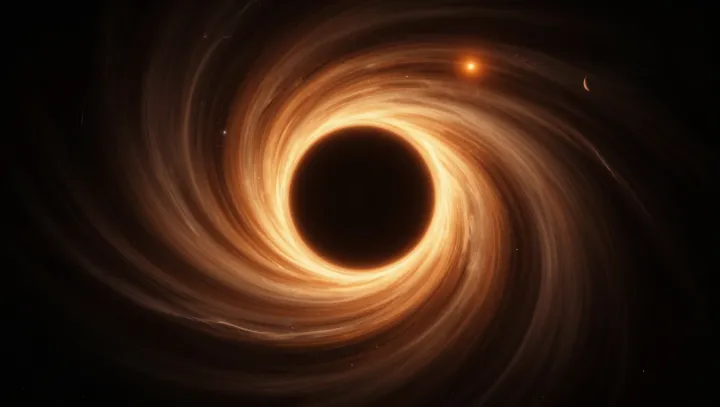
A rotating black hole is not just a gravitational sink but a colossal battery of rotational energy. General relativity predicts a warped region around it, the ergosphere, where spacetime itself is dragged faster than any spacecraft could ever spin. In that turbulent shell, theory says, part of the hole’s spin can be siphoned off and converted into usable energy rather than lost forever behind the event horizon.
The basic mechanism, known as the Penrose process, treats particles entering the ergosphere like assets in a risky trade: one fragment falls inward with negative energy relative to infinity, while its partner escapes with a surplus. Magnetohydrodynamic models sharpen this picture, replacing particles with magnetic field lines anchored in surrounding plasma that tap the hole’s rotational energy, not unlike an electromagnetic turbine. Unlike Hawking radiation, which leaks energy slowly through quantum effects, this spin extraction operates as a classical channel for energy transfer.
Astrophysicists already suspect that relativistic jets from active galactic nuclei are powered by such mechanisms, implying that black hole spin can drive enormous luminosity at high thermodynamic efficiency, seemingly outpacing many familiar engines of entropy increase. If those same principles could ever be engineered and controlled, the most extreme objects in the universe would cease to be only symbols of collapse and instead stand as demonstrations of how rotation, gravity and quantum fields can be woven into a single, audacious power plant.