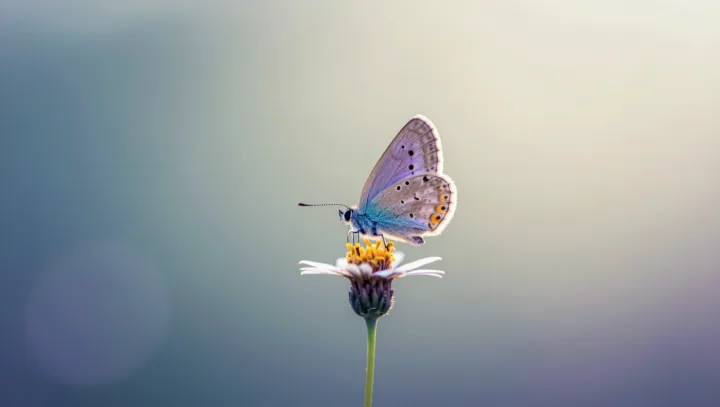
Under a microscope, a butterfly wing stops looking like a sheet of color and starts to resemble a tiled rooftop. Each scale forms a tiny shingle with ridges and air gaps that behave as an optical microstructure, steering incoming light instead of merely absorbing it as a pigment layer would.
Those nanoscale ridges create what physicists describe as a photonic crystal, a material whose periodic structure controls the propagation of electromagnetic waves. Through constructive interference and thin-film interference, select wavelengths are amplified and reflected while others are cancelled. In some of the most intense blues observed in butterflies, melanin or other pigments play only a supporting role, stabilizing the material rather than setting the hue.
Engineers studying these structural colors look to Maxwell’s equations and refractive index contrast to explain how such delicate architecture can generate saturated color at multiple viewing angles while remaining lightweight and flexible. The same light-bending principle that gives a butterfly its shimmering blue is now guiding bioinspired designs for anti-counterfeiting surfaces, low-energy displays and next-generation optical coatings.