
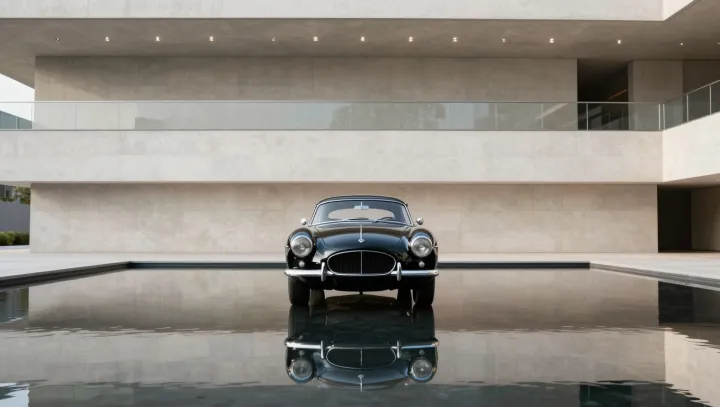
A black muscle car hangs upside down in a museum atrium, its wheels frozen above visitors’ heads. The familiar outline of power is still there, but its usual script has been inverted, literally and conceptually, turning a machine of motion into a suspended question.
By removing velocity and friction from the equation, the work exposes the gap between potential energy and kinetic energy. Horsepower figures, torque curves and acceleration times lose their marketable charge when gravity has the final word. The car’s chassis becomes an anatomical diagram of desire for dominance, separated from any real capacity to accelerate, escape or crash.
The installation also pries open the cultural physics of power. Muscle cars have long served as proxies for social status, gender codes and economic capital, a mobile display of surplus energy and access to fuel. In the gallery, that narrative experiences its own kind of entropy, as spectators walk calmly beneath an object that once promised danger and control at high speed.
Suspended in this engineered stillness, the car behaves less like a vehicle and more like a mirror tilted toward the viewer, reflecting how much of power is theater, and how quickly the illusion dissolves when motion is taken away.