
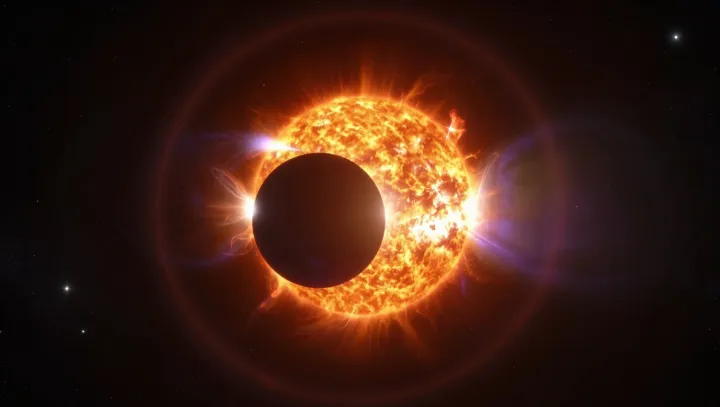
If Earth were squeezed down to the size of a grape, the largest known star would swell into a glowing sphere reaching roughly from Earth to the Moon. That single comparison turns an abstract astronomical number into something the human brain can almost sketch in a straight line.
Behind the metaphor sits standard stellar physics: gravity pulling inward, radiation pressure pushing outward, and a tug-of-war that sets a star’s radius and luminosity. At the level of particle physics, both the grape-sized Earth and the Moon-spanning star are dominated by the same ingredients, hydrogen and helium, obeying the same equations of state and thermodynamic entropy. What changes is the configuration of mass and energy, not the menu of atoms.
In a star, nuclear fusion converts hydrogen into helium in its core, raising temperature and pressure until hydrostatic equilibrium balances collapse. Earth, by contrast, sits as a solidified remnant, its internal heat driven mainly by radioactive decay and leftover formation energy rather than ongoing fusion. The comparison highlights a marginal effect that is anything but marginal in practice: a small shift in total mass, once past a critical threshold, unlocks whole regimes of stellar evolution and blows up familiar distances into cosmic architecture.