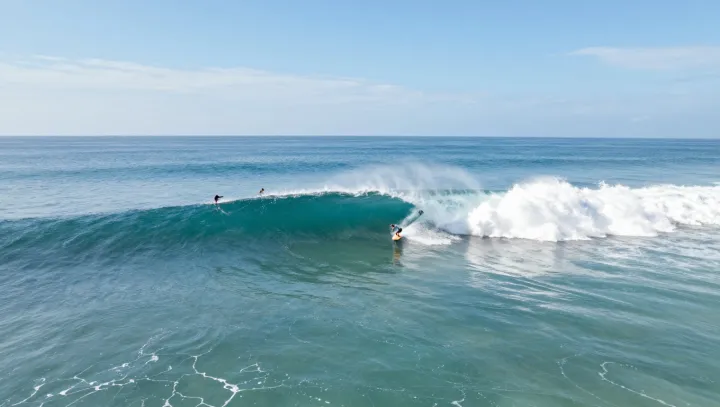
A shifting grid of peaks and channels decides who actually catches waves. Before any turn or aerial, ocean physics selects the real winners. Great surfers know that reading wave period, angle and rip currents changes how many waves they get, how long they ride and how much speed they can generate.
Wave period is the silent metronome of the lineup. Longer periods mean more energy flux in each set, steeper faces and heavier impact zones; shorter periods scatter weaker waves across the bank. Surfers who track this can position at the true focus point of refraction instead of chasing every lump. Wave angle then governs how that energy interacts with the seabed, shaping peel speed, shoulder length and the timing window for bottom turns.
Rip currents, driven by pressure gradients and conservation of mass, act as moving conveyor belts through the whitewater. A surfer who understands this hydrodynamics can use a rip as a low-effort paddle channel, return to the peak faster and enter the takeoff zone from a better line. Over a session, this creates a compounding edge in wave count, energy management and decision quality that no extra hour of practicing spins in the flats can match. When tricks are equal, the surfer who solved the fluid dynamics problem gets the best canvas.