
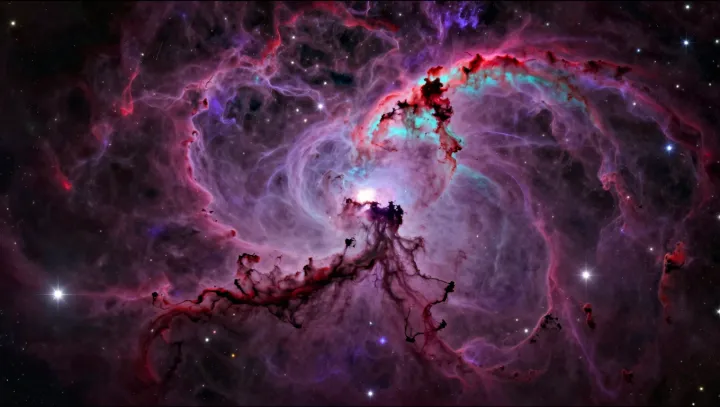
The central parsec of the Milky Way compresses about ten million stars into a volume smaller than the gap between the Sun and its nearest neighbor. Space there is no quiet vacuum but a three‑dimensional stellar city, where every orbit, collision and flare plays out under extreme crowding.
Astrophysicists describe this region as a natural laboratory for high‑density stellar dynamics. The local gravitational potential is dominated by the supermassive black hole, but the collective mass distribution of surrounding stars, gas and dark matter shapes orbital trajectories and energy transfer. Instead of isolated systems, stars experience frequent close encounters that can alter angular momentum, strip planetary systems and trigger tidal disruption events. Radiation pressure and intense magnetic fields sculpt the interstellar medium, driving feedback loops that influence star formation efficiency.
Observations across the electromagnetic spectrum, from infrared to X‑ray, are required to pierce the heavy dust extinction that hides the core in visible light. High‑resolution spectroscopy and proper‑motion mapping reveal velocity dispersions and mass functions that help constrain entropy growth in this crowded environment, where relaxation times and collisional cross‑sections differ sharply from those in the galactic disk. The result is a dense, evolving architecture that turns the notion of a lonely star into an edge case rather than the norm.