
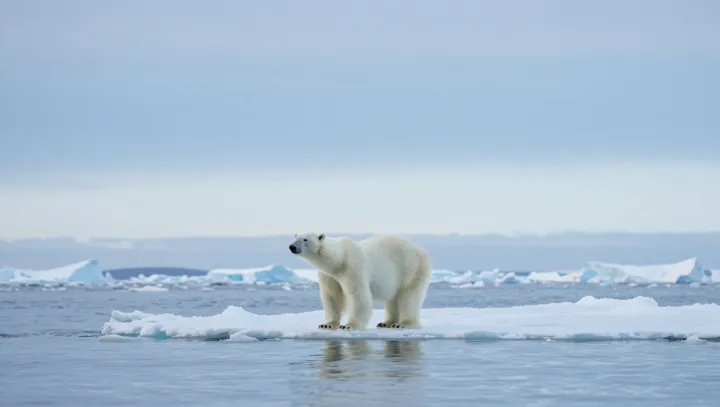
A polar bear is a near-perfect thermal ghost. On an infrared camera, its outline often blurs into the snow, while its breath and nose flare like tiny flares of signal against static.
The key claim is simple: the bear is not radiating much at the surface. Its hollow guard hairs behave less like white paint and more like optical fibers, channeling visible light to give that familiar pale coat, yet offering very low thermal emissivity toward the outside. Beneath that coat, a thick layer of adipose tissue and dense underfur create an extreme gradient, where metabolic heat is trapped and conduction through to the skin is sharply reduced.
What matters most is not color but physics of heat transfer. Infrared sensors detect thermal radiation, and the bear’s skin, though warm, is wrapped in insulation so effective that the outer fur approaches the temperature of the surrounding snowpack. Radiative flux at the surface drops. The result is a kind of biological stealth technology, in which convection and conduction are throttled so tightly that only small exposed regions, such as eyes and muzzle, stand out as bright signatures.
So the paradox holds only for human eyes. To visible light, the bear blazes against ice. To infrared detectors tuned to emissivity and temperature gradients, that same animal is little more than a faint distortion in a white field.