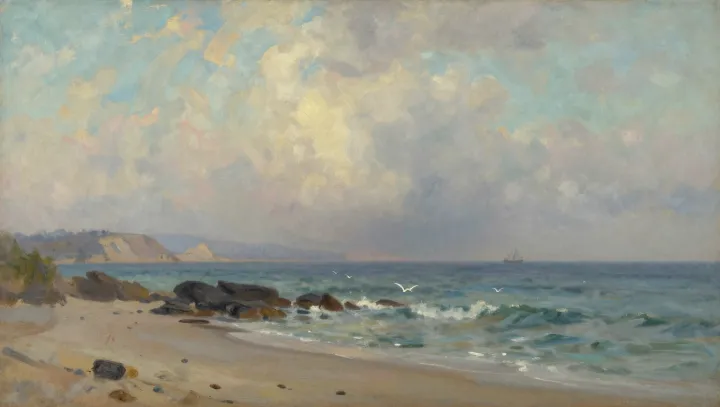
Light over Folkestone in Turner’s painting behaves less like poetry and more like a physics diagram in disguise. The pale, whitening sky near the sun, the soft gradient toward cooler tones, the veiled horizon over Dover: each visual choice matches what atmospheric optics now models with equations and radiative transfer codes.
Turner, I would argue, painted Rayleigh scattering long before the term existed. By draining intense blue from the sun’s vicinity and shifting it into higher parts of the sky, he mirrors the angular dependence of scattered short‑wavelength light that modern radiative transfer theory quantifies. That hazy band above the water reads like an intuitive map of optical depth, where increased path length through air and aerosols desaturates color and lowers contrast, exactly as current remote sensing algorithms predict.
More provocative still, his color decisions anticipate psychophysics. Turner nudges the eye from warm, high‑luminance yellows near the implied solar disk into subdued cyans and grays, echoing what color perception research describes with opponent‑process theory and luminance adaptation curves. The softened silhouettes of harbour structures and cliffs mimic what atmospheric scientists call Mie scattering from aerosols and sea salt, which flattens edges and shifts highlights. Where viewers once saw romantic mist, a climate modeler now sees an uncannily accurate qualitative rendering of scattering phase functions over the Channel.