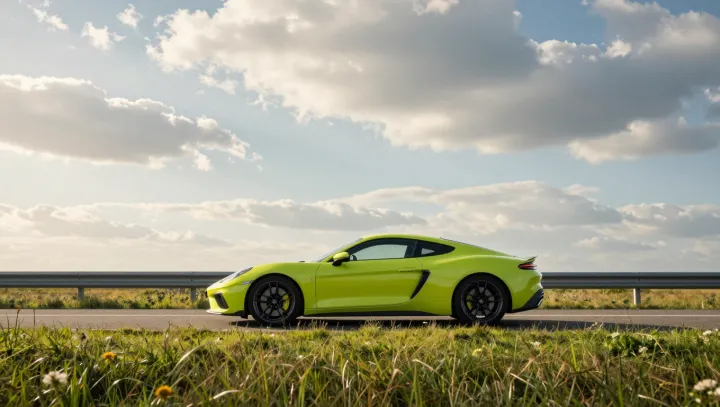

Air over a Lamborghini Huracan is not decoration; it is structure. At high speed, the car turns airflow into a vertical force that can exceed the mass of a common family car pressing it into the asphalt, while remaining fully street legal.
The effect starts with basic fluid dynamics. As air meets the front splitter and sculpted bumper, pressure increases ahead of the car while carefully shaped channels route flow toward radiators and wheel arches. Under the floor, a smooth tray and rear diffuser apply the Venturi effect, accelerating air and lowering static pressure, which raises net downforce on the chassis. Over the roof and engine cover, laminar and turbulent regions are choreographed to keep flow attached, delaying separation and reducing lift. Fixed wings or active aero elements then trade drag for additional negative lift, quantified as downforce in newtons rather than in vague notions of “stability.”
Vehicle dynamics and tire friction coefficients close the loop. Extra normal force from aerodynamic loading lets the tires transmit higher lateral and longitudinal forces before sliding. The car’s suspension is tuned so that this added load does not collapse ride height, preserving diffuser geometry and pressure gradients at speed. In effect, the Huracan treats air as a dense, invisible track surface that the bodywork sculpts, turning raw kinetic energy of the flow into mechanical grip that rivals the everyday weight of a family car.