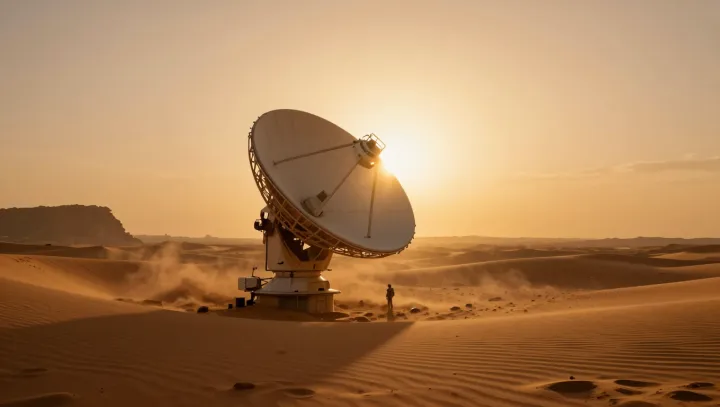
Dusk often makes the sky look more vivid just as the Sun itself slips out of sight. The reason is that the light path through the atmosphere grows longer, turning the sky into a large optical filter. Short blue wavelengths are stripped out by Rayleigh scattering, so the remaining beam arriving from below the horizon is enriched in reds and oranges.
Higher layers of air keep catching that sideways sunlight even after the solar disk vanishes for an observer on the ground. Dust, aerosols and thin clouds at altitude act as reflective screens. Through Mie scattering, they redirect this red‑shifted light over wide angles, effectively backlighting the underside of the sky while the direct beam to your eyes is already blocked by Earth.
Atmospheric refraction also bends rays around the edge of the planet, extending twilight and feeding more oblique light into those upper layers. Because rods and cones in the human retina respond differently as overall brightness falls, saturated reds and purples can appear especially intense against the darkening foreground. The Sun fades, but the sky overhead is still running on redirected light.