
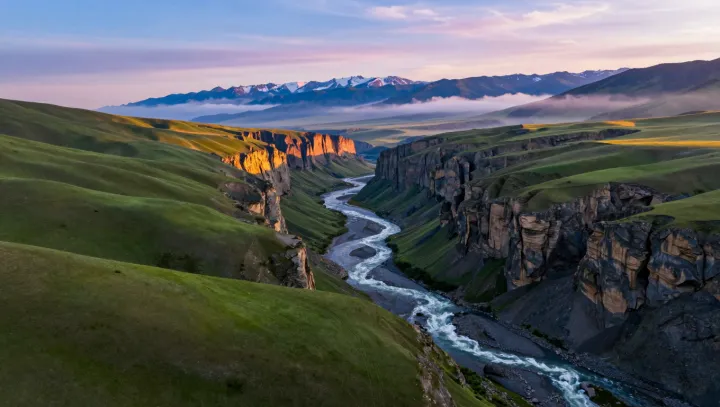
A shallow flow that cannot budge a single pebble can still be a canyon maker. The key is not force in a moment but force integrated over geological timescales. River water carries sand and silt that act as mobile drill bits, repeatedly striking and grinding the channel floor. Even low shear stress, applied without interruption, incrementally lowers the bedrock surface.
This process, known as fluvial incision, relies on both mechanical abrasion and chemical weathering. Dissolved carbon dioxide turns water slightly acidic, enhancing solution of minerals and creating microfractures that make rock easier to abrade. As regional base level, often controlled by sea level or tectonic uplift, drops, the river’s gravitational potential increases, maintaining a vertical erosion gradient. Over countless flow events, rare high-discharge floods briefly exceed the threshold needed to move boulders, scouring and resetting the channel.
Geomorphologists describe this with stream power theory, which links water discharge and channel slope to the rate of bedrock incision. Individually, each sand grain impact removes only microscopic volumes, an almost invisible marginal effect. Yet where uplift keeps lifting rock and the river keeps cutting down, the feedback between tectonics and erosion opens the full depth of a canyon, one imperceptible grain at a time.