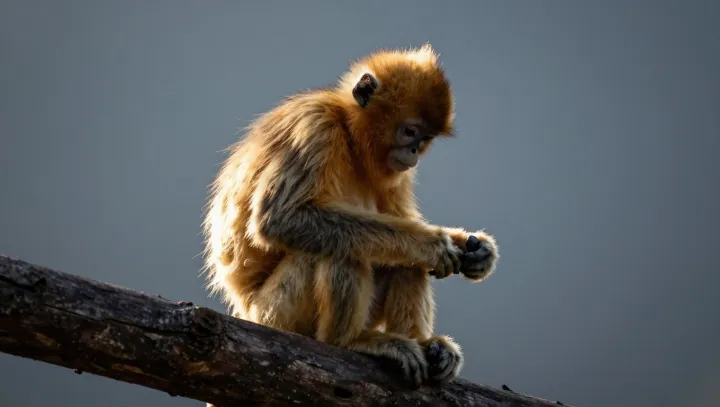
A head barely larger than a walnut holds one of the most studied brains in primate science. The squirrel monkey, marked by its dark facial “mask,” packs an outsized amount of neural tissue into a light, agile body, giving it a brain‑to‑body ratio that rivals far larger primates and turns it into a living reference system for intelligence research.
This disproportion begins with energetics. A primate brain demands a high share of basal metabolic rate, yet the squirrel monkey’s small frame and efficient locomotion free enough energy to sustain dense networks of cortical neurons. Its expanded cerebral cortex and highly laminated sensory areas give researchers a compact platform to track synaptic plasticity, functional connectivity and the scaling laws that link neuron counts to problem‑solving capacity.
Ecology and social structure then sharpen the edge. Life in visually complex canopies and in tightly knit groups selects for fine motor control, rapid visual processing and sophisticated social learning. Over evolutionary time, these pressures favor more neocortical surface area, richer prefrontal circuitry and enhanced working memory, all compressed into an animal that fits comfortably in a human hand. For neuroscientists, that combination of manageable size, intricate behavior and human‑like brain organization makes the masked squirrel monkey less a curiosity than a precise instrument for testing how primate intelligence is built.