
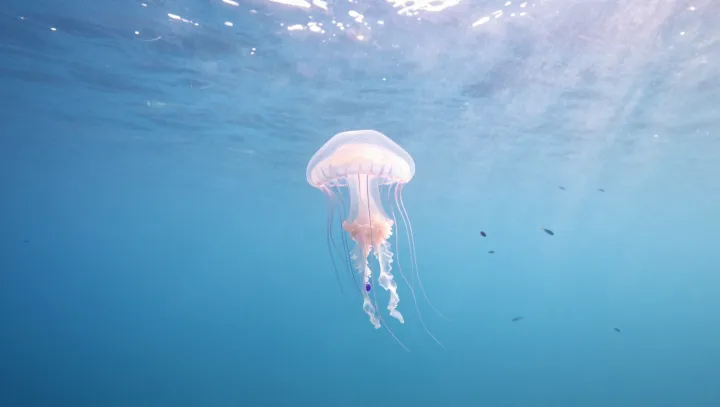
Tentacles hanging below a jellyfish are not decorations but weapons. Each strand forms a living net that intercepts passing plankton, tiny crustaceans and juvenile fish. Far from passive, many jellyfish pulse their bells to steer into dense prey patches, increasing the frequency of contact between tentacles and moving targets.
Biologically, that makes them textbook carnivores. Their tentacles and oral arms are packed with stinging cells called nematocysts, a specialized form of cnidocyte. When triggered by touch or chemical cues, these microscopic capsules fire barbed tubules and inject venom, rapidly disrupting ion channels and neuromuscular function in prey. The result is immobilization on contact rather than a slow filter-feeding process.
Once prey is snared, ciliary currents on the tentacles convey it to the central mouth and into a simple but efficient gastrovascular cavity. There, extracellular digestion breaks down tissue, and nutrients circulate through a radiating canal system that doubles as both gut and distribution network. Energy captured from zooplankton fuels growth, reproduction and the maintenance of their low but continuous basal metabolic rate. This suite of traits, from targeted bell pulsation to venom-driven capture and enzymatic digestion, places jellyfish firmly inside the logic of active predators rather than passive ocean debris.