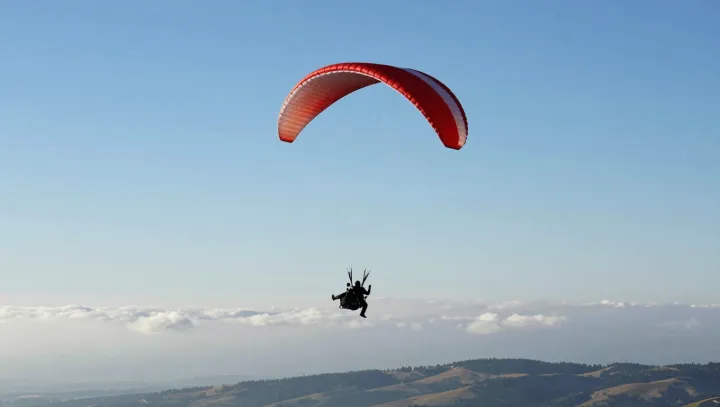
A paraglider wing does not float; it converts moving air into lift. Its fabric canopy forms an airfoil that creates a pressure difference between upper and lower surfaces, generating aerodynamic lift that counters gravity as long as airflow keeps streaming over the wing.
Staying airborne for hours depends on finding air that rises faster than the wing descends in still air, a rate defined by its glide ratio and sink rate. Columns of warmer air, known as thermals, and bands of rising air along ridges, called orographic lift, provide this free energy. When the wing enters such a column, the entire aircraft is carried upward, effectively resetting its potential energy without any engine thrust.
The pilot manages constant micro-adjustments to exploit small changes in relative airflow. By braking one side or shifting weight in the harness, they deform the wing’s angle of attack and roll angle, steering toward the strongest lift while avoiding aerodynamic stall. Variometers, which measure vertical airspeed and pressure changes, act as real-time feedback on convection strength, helping the pilot center the wing in the core of a thermal. Each smooth circle in rising air becomes another incremental climb, enabling long cross-country flights on nothing but invisible patterns in the atmosphere.