
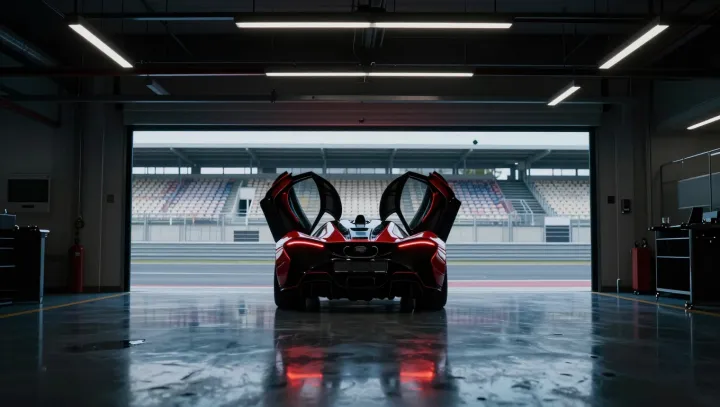
A smaller V6 now sits where McLaren’s V8 once ruled, and the Artura uses that change as a pivot rather than a retreat. By pairing a compact twin‑turbo six with an axial‑flux electric motor and a plug‑in hybrid battery pack, the company is aiming to reconcile tightening emissions limits with the expectations of a modern supercar buyer.
The combustion unit is engineered for high thermal efficiency and reduced internal friction, allowing the powertrain to rely less on displacement and more on combustion chamber design and turbocharging. The electric motor fills torque gaps, delivers instant response from zero revolutions, and supports a smoother torque curve, while regenerative braking manages energy flow in a way that echoes entropy management in a closed system. As a result, headline acceleration figures stay in supercar territory even as tailpipe output drops in electric‑only operation.
Underneath, the new carbon fiber monocoque is lighter and stiffer than previous tubs, lowering mass and improving torsional rigidity, which directly benefits lateral grip and braking performance. Integrating battery modules within this structure keeps the center of gravity low and maintains a favorable polar moment of inertia. For McLaren, the Artura’s architecture is less a nostalgic farewell to the V8 than a calculated redefinition of what its performance envelope should look like under a different set of constraints.