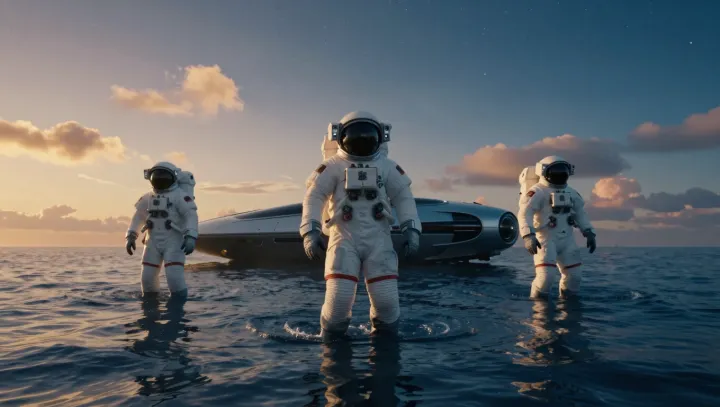
A black hole near an ice-blue ocean becomes the tight focus where Interstellar stops faking science and leans on general relativity. The film’s crucial claim is simple: time for astronauts close to a massive object can crawl, while time for distant observers races ahead.
The effect is not Hollywood time travel but gravitational time dilation, predicted by Einstein’s field equations and rooted in spacetime curvature. Near a black hole, extreme gravitational potential slows the local rate of proper time compared with clocks far away. The movie translates tensor calculus into a visceral gap: hours on the planet, years for mission control back on Earth.
This is a direct consequence of general relativity’s treatment of gravity not as a force but as the geometry of spacetime, where worldlines bend and clocks follow different paths through the same four-dimensional landscape. Interstellar exaggerates some parameters for drama, yet the asymmetry it shows between onboard aging and distant history is entirely consistent with mainstream astrophysics, not a scriptwriter’s loophole in physics.