
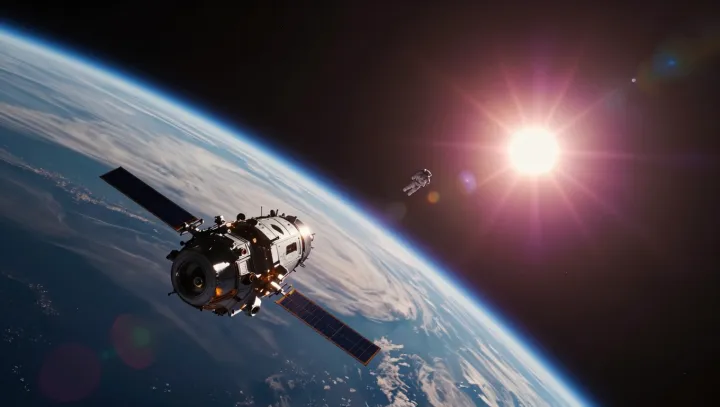
A satellite screaming around Earth at orbital velocity carries far more energy than a speeding bullet, yet some of that hardware manages to glide home in one piece. The key is not brute force but careful choreography of how that kinetic energy is bled off into the atmosphere and then into the surrounding air as heat.
The journey starts with a deorbit burn, a short rocket engine firing that reduces orbital velocity just enough to drop the craft into a controlled descent. Orbital mechanics dictates that a small change in speed reshapes the entire trajectory, turning a stable orbit into a path that intersects denser air. From there, atmospheric drag takes over as the main braking force, converting motion into thermal energy according to basic thermodynamics.
To avoid structural failure, reentry capsules use a blunt-body heat shield. This shape creates a detached shock wave in front of the vehicle, keeping most of the superheated plasma at a distance while ablative materials slowly vaporize and carry heat away, much like controlled entropy increase in a closed system. Carefully chosen flight angles, known as reentry corridors, spread heating over a longer path so no single part overheats.
More delicate satellites do not usually attempt to survive reentry at all. Engineers design many of them to burn up intentionally, sizing components so that aerodynamic heating and mechanical loads destroy them before they reach the ground, turning the same hostile physics into a safety feature rather than a threat to returning crews or equipment.