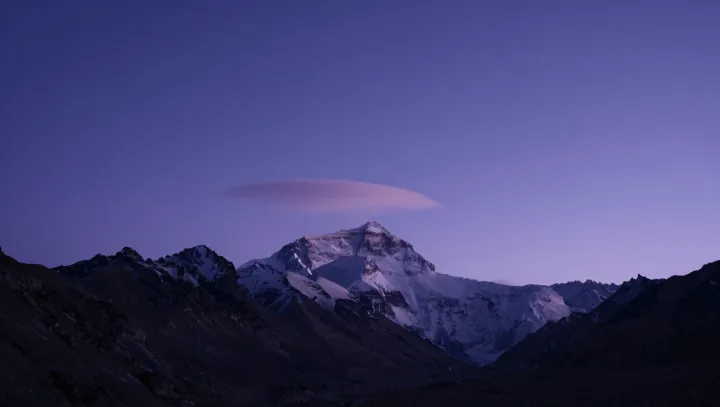
A mountain that sits at a latitude suited to year‑round golf still carries the world’s southernmost permanent snow‑capped peak in the Northern Hemisphere. Its survival rests on a simple equation: altitude compensates for latitude. As air rises along the massif it expands and cools, pushing the freezing line downward until it intersects the summit plateau.
Glaciologists describe this as a local reset of the lapse rate and surface energy balance. Thin air reduces atmospheric pressure and longwave back‑radiation, while frequent orographic lift wrings extra moisture from passing air masses. Snowfall can exceed melt for just enough days that a small glacier persists, even though nearby lowlands support greens, fairways and short sleeves through every season.
The so‑called dragon‑like ridgeline is more than a visual metaphor. A serrated arête funnels wind, accelerates sublimation on exposed spines and traps drifting snow in shaded hollows. This microtopography creates sharp gradients in albedo and ablation across only a few hundred meters. One flank can host compact firn; another, bare rock and talus. The ridge effectively sketches a contour map of marginal glacial survival, tracing the knife‑edge boundary where a slight shift in temperature, precipitation or wind direction would erase the peak’s last perennial ice.