
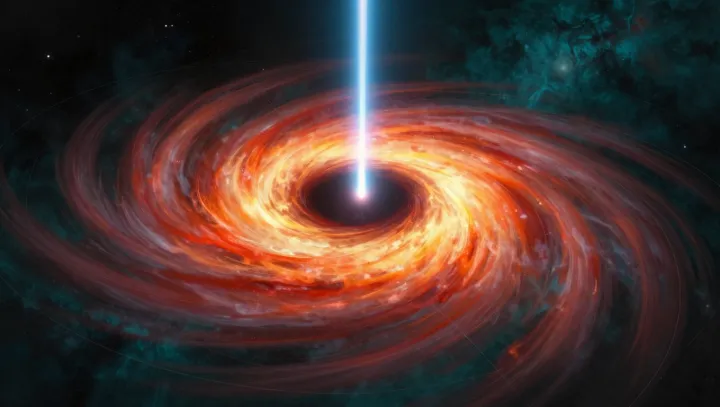
The event horizon of a black hole, once treated as a one-way information shredder, is being recast as a dynamic ledger for the universe. Recent theoretical work in quantum gravity suggests that the horizon’s entropy is not a mere bookkeeping device but a structured inventory of microscopic states.
In this view, the Bekenstein–Hawking entropy, tied to the horizon’s area, becomes a constraint on how spacetime can evolve, rather than a sign that information is lost. The holographic principle extends this logic: data about matter and radiation that approach the horizon are encoded on a lower-dimensional surface, with quantum entanglement weaving correlations between interior and exterior descriptions.
If that surface record is complete, it does more than catalogue the past. It specifies which future configurations remain compatible with unitarity and entropy increase, turning the horizon into a probabilistic blueprint for cosmic outcomes. Instead of a void that erases history, the black hole appears as an information boundary where the geometry of spacetime quietly scripts what can happen next.