
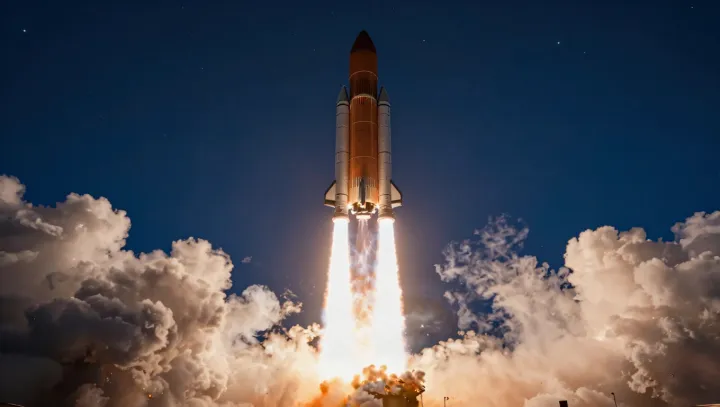
A rocket’s falling hardware is not failure; it is the core design feature that makes orbit possible. Instead of one enormous tank, most launchers are built as stacked stages that ignite, burn out, and then separate in sequence.
The reason comes from the Tsiolkovsky rocket equation, which links change in velocity to exhaust velocity and the propellant mass ratio. A single stage that must carry all its empty tanks, engines, and structure to orbit drags huge inert mass. That dead mass lowers the achievable delta‑v below orbital velocity long before propellant runs out, even with high‑performance chemical propellants.
Staging discards empty tanks and engines once their propellant is spent, resetting the mass ratio in favor of the remaining vehicle. Each stage works only over part of the ascent profile, so its engines and structure can be optimized for specific ambient pressure and thrust‑to‑weight ratio. The stack of stages effectively multiplies the total delta‑v in a way no single monolithic stage can match under current propellant chemistry and structural materials.
Multi‑stage flight therefore acts as a controlled, planned self‑amputation of inert mass. By throwing away hardware in flight, rockets cross the velocity threshold where a vehicle that kept every kilogram from liftoff would stall.