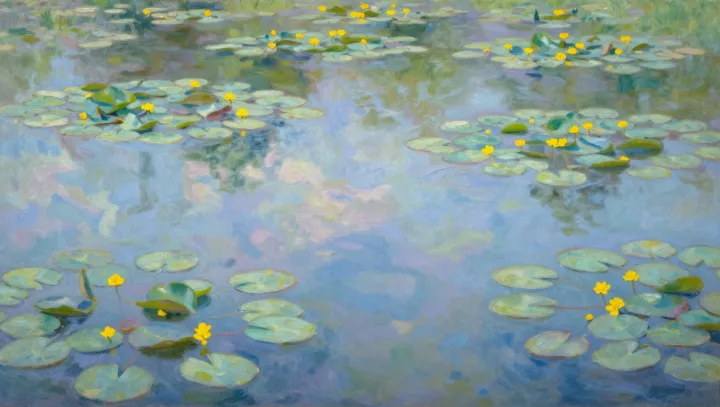
A garden, not a canvas, carried Monet’s most radical claim about art. The space he built and rebuilt at Giverny functioned less as a backdrop than as an open-air research station, designed to test how light, water, and foliage could be recomposed before they ever reached a stretcher.
Monet treated the site as an experiment in optics rather than simple horticulture. He diverted water, imported plants, and controlled sightlines to stage repeated encounters with reflection, refraction, and atmospheric scattering. Instead of relying on memory, he tuned the environment so that retinal afterimage and color contrast were constantly in play, turning the garden into a continuous generator of visual data from which the paintings drew.
This engineered ecosystem also side-stepped the entropy that haunts a finished object. While a canvas fixes one solution to the problem of representing light, the garden sustained countless marginal effects across mist, lilies, and sky, renewing the variables every hour. In that sense, the paintings appear as snapshots of a larger, evolving system, and the garden becomes the real work: a self-refreshing field of perception that kept extending the experiment beyond the frame.