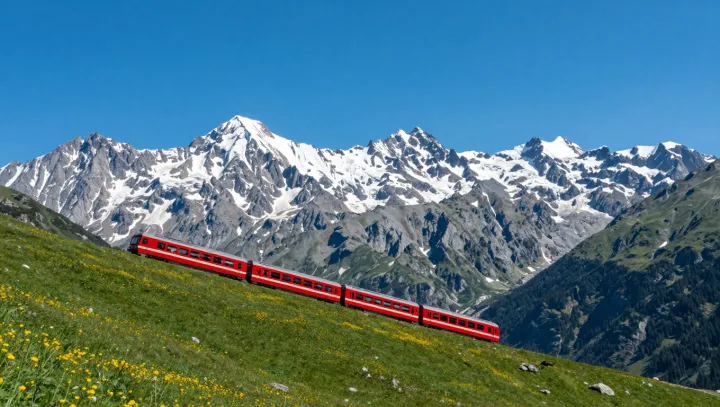
Blue-white ice withdraws from the rock faces of Jungfrau even as scientists treat it as a calibrated archive of climate history. The surface thins and dark crevasses widen, yet deep layers remain sealed, storing traces of air, dust and chemistry laid down in sequence far below the retreating margin.
That tension rests on how glaciers grow and decay. Accumulation and ablation shape a moving conveyor belt of firn and ice, but mass loss at the tongue does not erase the stratigraphy locked in higher elevation basins. Within those compacted layers, ratios of oxygen isotopes and trapped greenhouse gas concentrations record shifts in temperature and radiative forcing with a precision that rivals laboratory instruments, even as the ice itself migrates and thins.
To turn this fragile body into a time machine, researchers rely on ice-core drilling, radiometric dating and gas chromatography, treating the glacier as both specimen and sensor. Loss of volume narrows the archive and raises concerns about entropy and data gaps, yet the remaining columns still encode climate signals spanning roughly one hundred millennia. The paradox is that the very processes accelerating melt also sharpen interest in the archive before it disappears from the high Alpine skyline.