
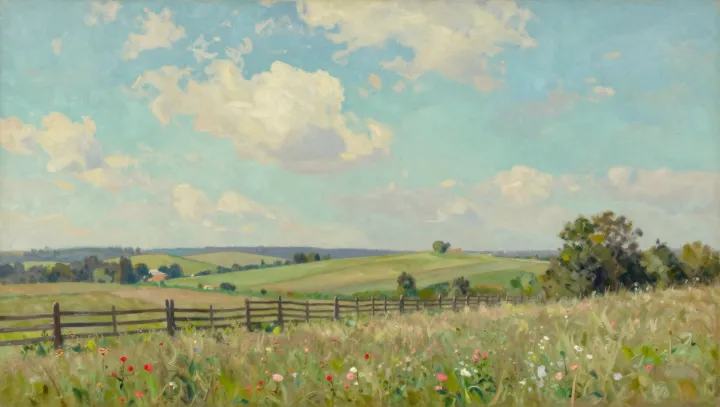
A painted meadow has become a research site without soil, fences or instruments. Alfred Sisley’s landscape is now read as a visual dataset, dense with information about light, weather and vegetation that no surveyor ever logged.
Because Impressionism was obsessed with optical truth, Sisley worked like a human sensor, tracking luminance, atmospheric scattering and chromatic contrast in real time. His layered brushstrokes separate direct sunlight from diffuse skylight, almost like a primitive spectroradiometer capturing the light spectrum. Art historians and conservation scientists can reverse‑engineer those choices, comparing pigment reflectance and brush direction to reconstruct sun angle, cloud density and even relative humidity via observable haze and visibility gradients.
Botanists and environmental historians, meanwhile, mine the foreground grass and clustered trees for evidence of phenology and species composition. Leaf shape, canopy density and flowering stages support inferences about local growing degree days and baseline photosynthesis rates, giving the painting the status of proxy data, comparable in spirit to a tree‑ring archive. Once plotted against maps, pollen records and contemporary photography, Sisley’s meadow functions as a time capsule for microclimate and plant communities, turning aesthetic decisions into analyzable climate signals.