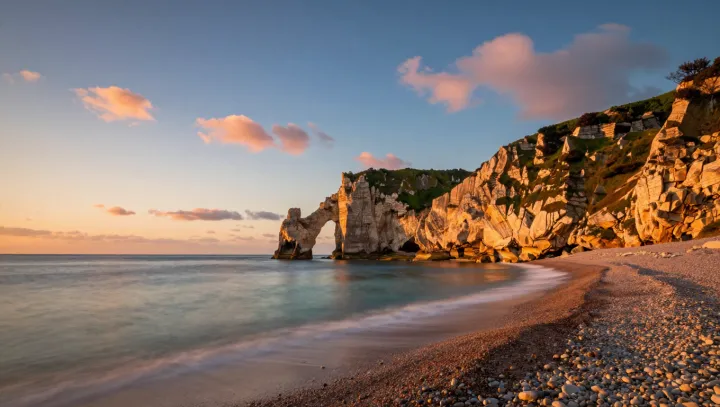
A limestone arch on a former private estate now functions as a compact archive of deep time, its layered rock recording shifts in climate, sea level and tectonic stress. What was once a secluded coastal backdrop has become a key reference point for tracing geological change locked into the cliffs.
Researchers read the arch through stratigraphy, using each band of sedimentary rock as a marker in a long sequence of marine deposition and uplift. Calcium carbonate crystals, pressure fractures and fossil shells offer physical evidence that allows scientists to reconstruct ancient shorelines and ocean chemistry, rather than relying on abstract models alone.
Wave erosion, hydraulic action and rock fatigue have carved the arch into its current shape, selectively removing weaker strata while leaving more resistant layers as a natural bridge. This process exposes cross-sections of the coastal platform similar to a cut core sample, but on the scale of a landscape, enabling comparative analysis across multiple rock units in a single view.
As access restrictions eased and coastal conservation policy expanded, the once-quiet estate frontage drew systematic field surveys, drone mapping and geophysical imaging. The arch’s continuous sequence of beds, accessible at eye level, now anchors studies of sediment transport, structural geology and long-term shoreline retreat, turning a private boundary into an open laboratory for reading Earth’s past.