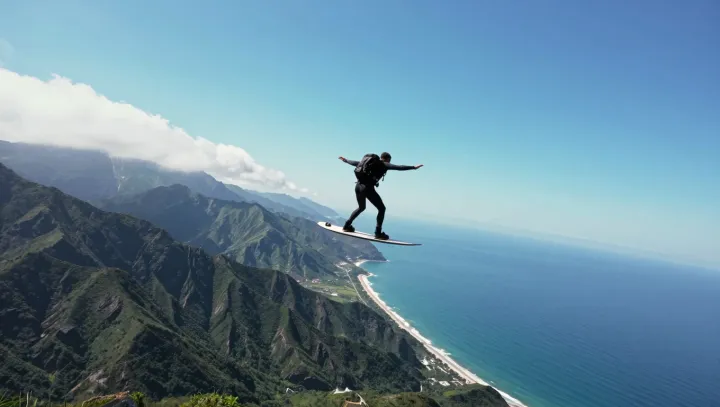
Airflow shapes every move long before a board cuts through the sky. At elite level, style is not an overlay; it is the visible trace of precise aerodynamic management under terminal velocity.
What looks like looseness begins with a rigid mental model of drag coefficients and center of mass. Surfers use angular momentum like a currency, spending it through micro‑adjustments of wrists, toes and hip rotation. A hand opens by a few square centimeters to add form drag, slowing a spin; a knee tucks to shift the moment of inertia and accelerate rotation. Proprioceptive feedback and vestibular signals run a permanent feedback loop, updating body angles within milliseconds as the relative wind shifts.
Training breaks the paradox. On the ground, athletes map each pose to a specific airflow pattern using wind tunnels, high‑speed video and inertial measurement sensors. Repetition builds procedural memory in motor cortex and cerebellum, turning explicit calculations into something closer to reflex. In freefall, they are not solving equations; they are querying a deeply coded lookup table of muscle activations that keeps the silhouette soft and flowing while quietly policing boundary conditions where a graceful corkscrew could decay into chaotic tumble. The performance sells art, but it is engineered around entropy control.