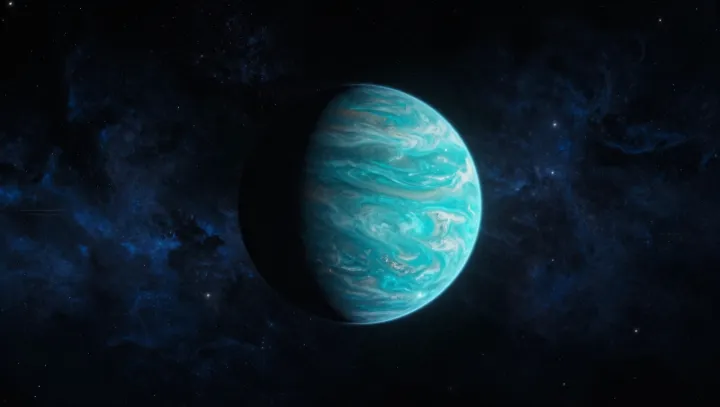
A distant star system now hosts the most provocative result in NASA’s exoplanet catalog. The agency has confirmed a planet that matches Earth in overall size and orbits within its star’s Goldilocks zone, where surface temperatures allow liquid water under the right atmospheric pressure.
Analysis of the planet’s transit signal indicates a rocky body with a radius close to Earth’s and an orbital distance that yields a moderate incident flux, the key energy input that shapes climate and drives radiative equilibrium. That combination puts the world in a narrow band long modeled by planetary scientists as the habitable zone, the range where water can persist in liquid form on a solid surface.
Spectroscopic measurements and follow-up modeling will target atmospheric composition and surface conditions, using tools from comparative planetology and concepts such as greenhouse forcing and planetary albedo. If clouds, gases and surface reflectivity align within known bounds of climate stability, this planet will stand as a strong test case for the entropy-driven evolution of habitable environments beyond the Solar System.
The discovery arrives as statistical surveys of exoplanets are approaching the scale where marginal effects matter, turning individual worlds into data points for estimating how common Earth-like conditions may be in the wider galaxy. A single confirmed planet in a Goldilocks orbit does not answer the question of life, but it sharpens the question of how rare our own circumstances really are.