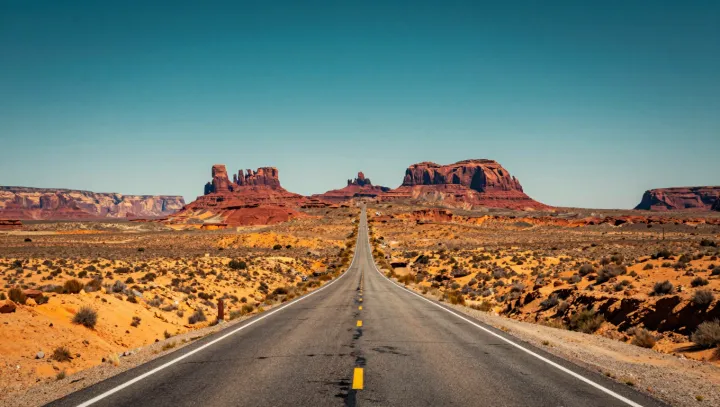
Sheer rock columns stand on a desert floor that looks almost too smooth to have built them. That apparent paradox is the slow work of erosion stripping away a once-continuous rock platform and leaving only its most resistant fragments behind.
Monument Valley began as thick, horizontal stacks of sandstone and shale laid down in ancient river and marine basins. Later tectonic uplift raised this sedimentary package into a broad plateau, exposing it to surface processes that obey basic thermodynamics: increasing entropy by breaking solid rock into dispersed grains. Mechanical weathering and chemical weathering then attacked different layers at different rates. Softer shale weakened quickly, while harder sandstone, cemented by silica or calcite, maintained a higher structural threshold.
Differential erosion exploited every fracture. Sheet wash and overland flow shaved the plateau into flat benches, evacuating loosened sediment through an evolving drainage network. As undercutting removed the soft bases of cliffs, retreating escarpments segmented into mesas, then buttes, then slender spires. Gravitational stress and joint patterns acted as a kind of selection pressure, preserving only blocks with geometries that could withstand repeated freeze–thaw cycles and thermal expansion. The result is a flat desert floor dotted with towers that no longer grow, but continue to narrow and crumble, remnant markers of a plateau that once covered the entire scene.