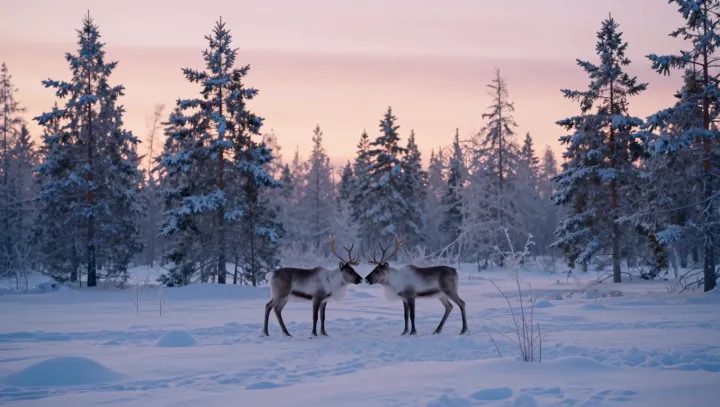
Snow does not look white to a reindeer. Laboratory tests on reindeer eyeballs showed that their corneas and lenses transmit ultraviolet wavelengths that human eyes block. Recordings from retinal cells confirmed that photoreceptors respond to this high‑energy band of light beyond the human visual spectrum.
Biologists then took a closer look at the Arctic landscape under ultraviolet illumination. Lichen, the main winter food, reflects ultraviolet poorly and appears dark. Wolf and fox fur, urine trails, and human infrastructure such as power cables and pipelines absorb or reflect ultraviolet differently from snow, standing out in sharp contrast. For an herbivore on open tundra, that contrast is survival data.
The mechanism trades optical safety for information. Human eyes filter ultraviolet to protect the retina and reduce chromatic aberration, but reindeer tolerate scattered ultraviolet in exchange for an expanded spectral sensitivity curve. In extended low sun and long twilight, when visible light is scarce and snow glare dominates, that extra slice of the spectrum turns an apparently blank white field into a map of predators, food patches, and man‑made obstacles.