
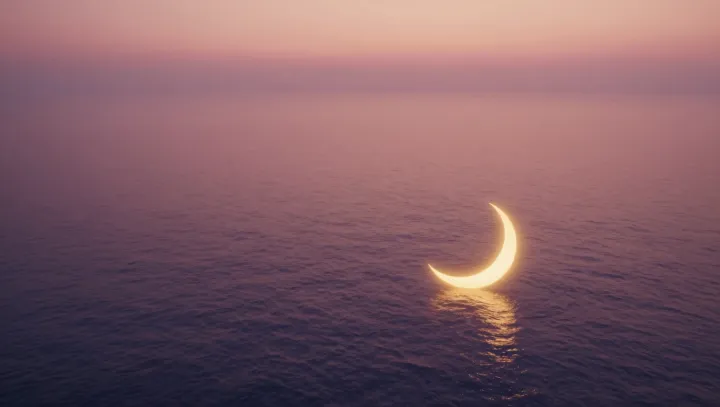
A bright road of moonlight appears on the sea, rising straight toward your feet. Shift along the shore, and that same path seems to realign and follow. No invisible spotlight tracks you. Geometry does.
Each patch of water acts as a tiny mirror. Only points on the surface that satisfy the law of reflection, where the incident angle equals the reflected angle, send moonlight directly into your eyes. Because the ocean surface is covered with countless small waves and facets, a whole band of points happens to meet that condition, forming a vertical streak of light that looks like a continuous “path”. If you move, the required specular reflection angles change, so a different set of water patches now sends light to your eyes, and the band appears to slide with you.
The phenomenon also relies on luminance contrast and the limits of human visual acuity. Against a dark sea, even modest increases in reflected radiance register as a bright track. At any given moment, every observer at a different position sees a separate path, each defined by their own line of sight and the local wave slope statistics. Nothing on the water is reorienting toward a single viewer; the optical setup quietly updates for everyone at once.