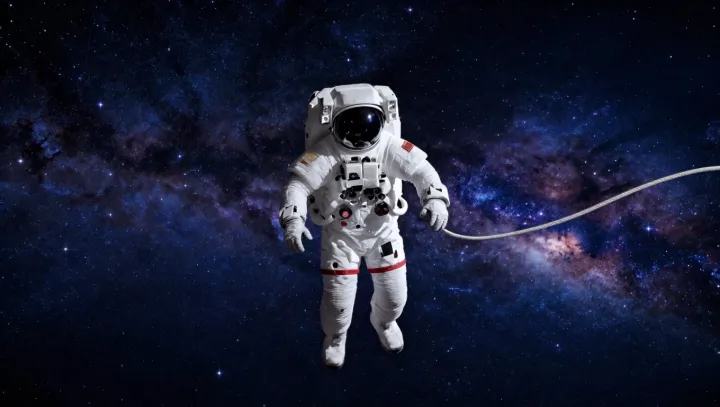
Blinding white dominates spacewalk photos because physics punishes any darker choice. Outside the vehicle, a suit faces unfiltered solar radiation, vacuum and extreme temperature swings. White fabric, with high albedo, reflects most incoming solar energy and slows radiative heating. It also limits emissivity shifts that could drive rapid heat loss into deep space, helping the life-support system keep metabolic heat within a safe band.
The orange that appears during launch and landing answers a different survival problem. In those phases, the main threat is not vacuum exposure but high-speed abort into ocean or land. The suit becomes a search-and-rescue beacon. Fluorescent orange maximizes contrast against water, clouds and terrain, improving detection by human observers and optical sensors. It also pairs with flotation systems and pressure protection designed for rapid recovery after vehicle failure.
The color swap therefore encodes two distinct design regimes. White supports thermal control, radiative balance and insulation during extravehicular activity. Orange optimizes visual acquisition, localization and rescue logistics in the dense atmosphere. The same body, the same spacecraft program, but two survival equations: one dominated by radiative heat transfer, the other by line-of-sight detection probability.